

INU Oceanography Ph.D. Student Seoyoung Kim Reveals Link Between Water Mass Distribution and Emissions of Potent Greenhouse Gases N₂O and CH₄ in the Northern East China Sea
- NO
- 431090
- Date
- 2026-09-29
- modification day
- 2026-09-29
- Writer
- 홍보과 (032-835-9490)
- Count
- 7

Seoyoung Kim, Ph.D. Student in Oceanography at Incheon National University
A joint research team comprising Seoyoung Kim (co-first author), a Ph.D. student in the Department of Oceanography at Incheon National University; Professor Ilnam Kim (academic advisor and corresponding author); and Dr. Heetae Ju (co-first author) of the National Institute of Fisheries Science examined seasonal changes in water masses and surface nitrous oxide (N2O) and methane (CH4) in the northern East China Sea. The findings were published in the SCIE-indexed international journal Estuarine, Coastal and Shelf Science (IF: 2.8).
The research team conducted four surveys in the northern East China Sea and compared N2O and CH4 characteristics among different water masses based on the relative influence of Changjiang Diluted Water and Tsushima Warm Current Surface Water. The distribution of water masses in the region changed by season, while N2O and CH4 also showed seasonal and spatial variations associated with these changes.
In particular, nutrient concentrations and surface N2O and CH4 concentrations were generally higher in areas more strongly influenced by Changjiang Diluted Water. When observations from all four seasons were combined, the movement of both gases from the sea surface to the atmosphere was also greater in areas influenced by Changjiang Diluted Water than in areas influenced by Tsushima Warm Current Surface Water.
The study examined N2O and CH4 across all four seasons in the northern East China Sea and showed that their seasonal and spatial distributions were related to changes in water masses. The four-season observations also showed that both gases moved from the ocean to the atmosphere in the study area.
Based on the four seasonal surveys, the research team also estimated the annual amounts of N2O and CH4 moving from the study area to the atmosphere. The findings provide information for future studies examining changes in N2O and CH4 in the East China Sea.
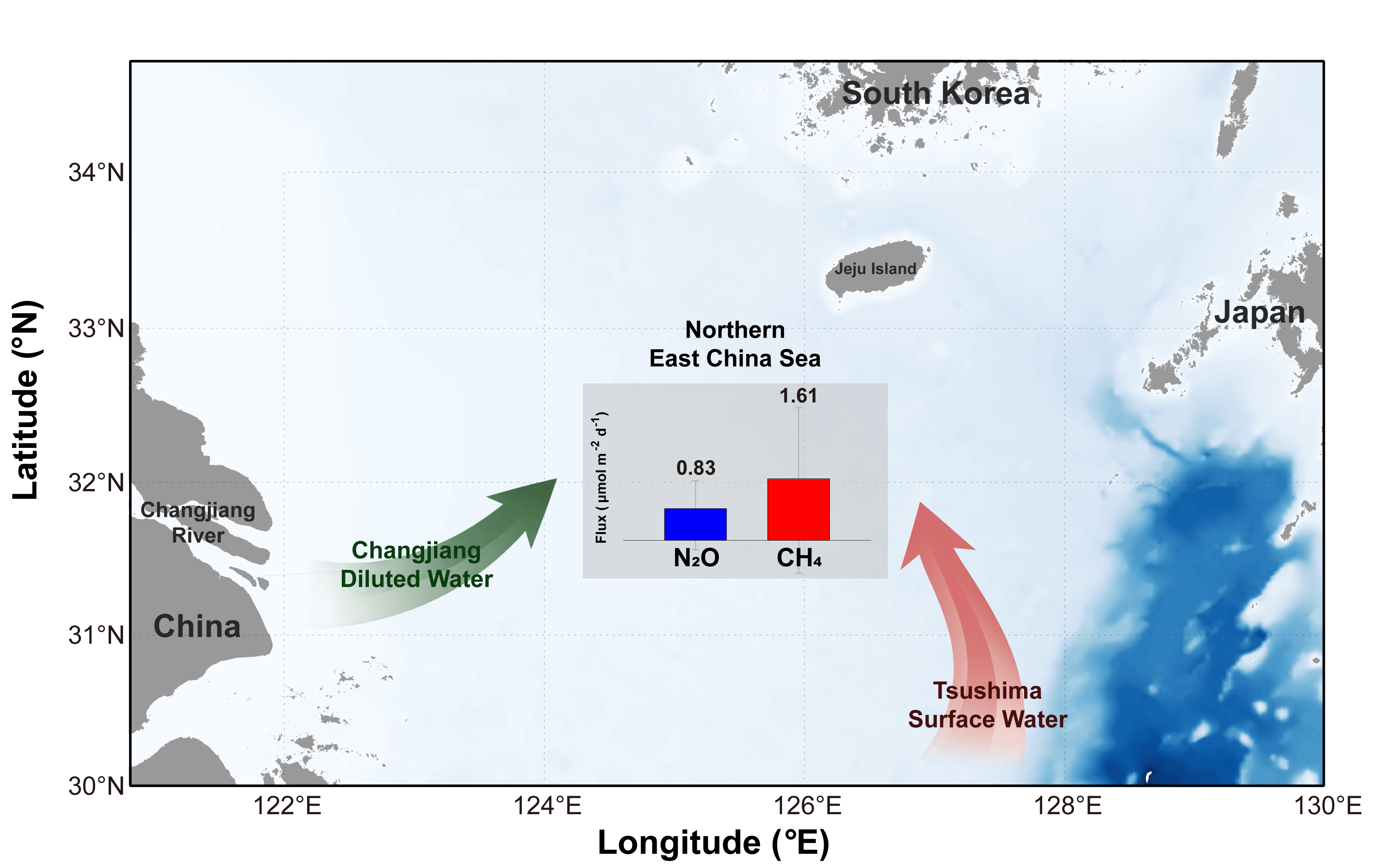
Water mass distribution and air-sea fluxes of nitrous oxide (N2O) and methane (CH4) in the northern East China Sea (provided by the research team).
The study area is influenced by Changjiang Diluted Water flowing in from the west and Tsushima Warm Current Surface Water entering from the southeast. Observations across all four seasons showed movement of both gases from the ocean to the atmosphere.
- Attachment
- There are no attachments.